

Economic Challenges of the Mass Deportation Plan
The recent election of Donald Trump as president has reignited the debate over immigration in the United States and the consequences his policies could have on the economy and the workforce. With his promise to implement a massive deportation program, Trump has signaled his intention to address the presence of undocumented immigrants in the country. However, this strategy could have significant repercussions not only for migrant workers, but also for various industries that rely on their labor. Amid this uncertainty, it is crucial that skilled workers, such as landscapers and cleaners, understand the implications of these policies. Trump's proposal aims to reduce the number of undocumented workers, as well as to review the status of many who currently hold temporary work permits. This is of particular concern for sectors such as construction, agriculture and maintenance, where a significant proportion of the workforce is made up of immigrants. The lack of available workers to fill these vacancies could lead to increased costs in these industries, ultimately affecting consumers and the overall economy. In addition, experts in the field warn that such policies could create labor shortages in vital sectors, exacerbating the talent availability problems already facing the U.S. labor market. In this article, we will explore how the proposed mass deportations could affect immigrant workers and the economy as a whole, and what steps those interested in obtaining work permits can take in this uncertain environment.
How will mass deportation affect immigrant workers?
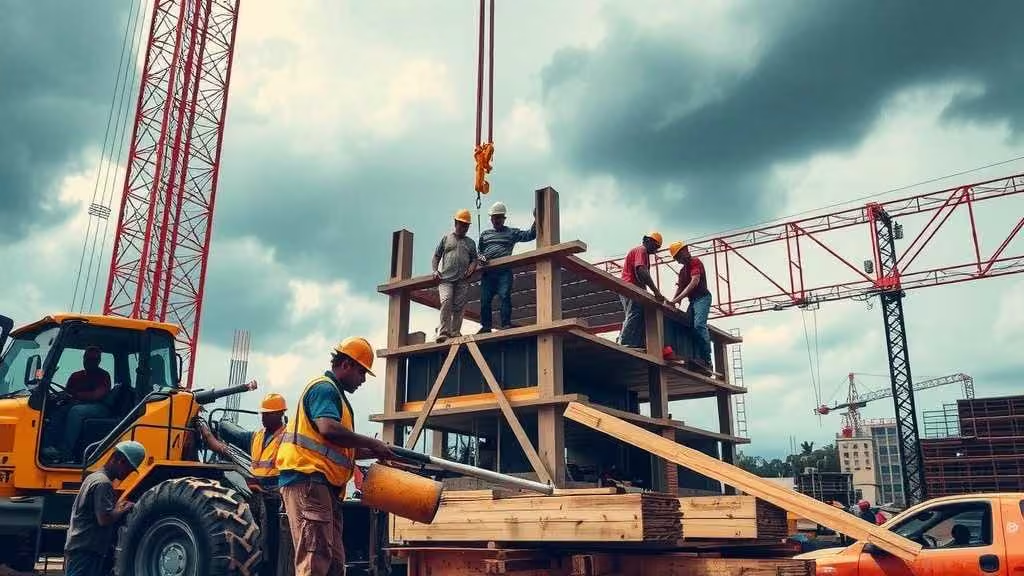
Figures indicate that there are currently about 11 million undocumented immigrants in the United States, of which about 7 million are employed. Many of these workers are employed in trades that are essential to the functioning of various industries. The implementation of a mass deportation program would not only affect undocumented workers, but could also create a labor vacuum that would be difficult to fill. The construction and agriculture sectors, for example, could face large losses. An estimated 14% of construction workers are undocumented, meaning that labor shortages could cause construction delays and increase project costs. Likewise, many agricultural workers who pick and process food are also undocumented, which could affect production and, eventually, food prices.Why is a focus on skilled workers vital?
In addition to problems with unskilled labor, immigration policies could negatively impact skilled workers. The technology sector, for example, relies heavily on workers on H-1B visas. If restrictions on these visas are tightened, it could result in a talent drain to other countries where competition for skilled workers is less restrictive. This poses a worrisome scenario for U.S. companies that require sophisticated technical skills. If these companies cannot attract the best talent, they could lose competitiveness in the global marketplace. Therefore, there is a need for an immigration approach that is flexible and allows for the arrival of skilled workers, as well as the regularization of those already in the country.
The impact of deportations on the economy
According to recent studies, a mass deportation program could cost the country between $1.1 trillion to $1.7 trillion in terms of GDP. This is because the reduction of available workers will not only increase costs in various industries, but will also affect consumers through higher prices and product shortages. The cost of a deportation program could be astronomical, considering that the practical implementation of such a policy would be a monumental task. Economic experts have pointed out that deporting immigrants would not only be difficult, but also extremely costly. As the labor force shrinks, businesses will see their operating costs increase, which will likely be passed on to the end consumer.What steps should migrant workers take?
In this changing context, undocumented workers who wish to remain in the United States should consider their options. Seeking appropriate legal advice is critical to understand what permits and avenues of regularization are available. There are temporary programs and work permits that could be beneficial to those who meet certain requirements. In addition, it is vital to stay informed about immigration policies and how they may affect the development of employment opportunities. Organizing in communities and support networks can also be an important and useful step for undocumented workers in their search for stability and job security.Conclusion
The Trump administration's mass deportation proposal marks a turning point in the U.S. immigration dialogue. While these measures are promised to bring long-term economic benefits, the immediate effects on the immigrant workforce are of great concern. For skilled and unskilled workers seeking job opportunities in the U.S., understanding the legal landscape and acting strategically accordingly could be the key to navigating this complicated environment. Changes in immigration policy will affect not only the lives of millions of workers, but also the economy as a whole. While the need for a skilled workforce is clear, the importance of providing a path to legalization for those who have already made significant contributions to society and the economy must also be recognized. We invite you to follow us on our social networks for more information about immigration opportunities and to stay up to date on legal changes. Visit our Facebook page, Instagram or our Google Business post for more details.What is Trump's mass deportation plan?
It is a strategy proposed by President Trump to deport undocumented immigrants on a large scale.
How will this affect immigrant workers?
It could result in job losses and labor shortages in sectors such as construction and agriculture.
Which industries will be most affected?
Construction, agriculture and the service sector are some of the most impacted.
What options do undocumented workers have?
They should seek legal advice and consider regularization possibilities through work permit programs.
What is the impact on the economy?
It is estimated that the economy could lose between $1.1 trillion to $1.7 trillion in GDP due to the reduction in the labor force.